

Usually, yes. Having VA health care does not make Medicare unnecessary for most veterans. You can use VA benefits and Medicare at the same time, but they are separate coverage paths. VA care can be an excellent fit for routine care, prescriptions, and authorized services. Medicare can give you another way to receive covered care outside the VA system, including from civilian doctors and hospitals that accept Medicare.
The choice is not about declaring one program better than the other. It is about avoiding a gap in options later. A veteran may be satisfied with VA care today, then need a civilian specialist, move, travel, face a long wait, or simply want more choice. Those are the moments when the Medicare decision made at age 65 can matter most.
This guide focuses on the practical question behind the paperwork: what do you gain, what could you risk by waiting, and what should you verify before enrolling or declining coverage? For a broader explanation of how appointments, bills, prescriptions, and community care work together, read D M Cook Insurance’s Medicare and VA benefits guide.
The Short Answer: VA Care and Medicare Can Work Together
VA health care and Medicare are not two halves of one plan. You generally choose which benefit to use for a particular service. Medicare pays for Medicare-covered care from Medicare providers. VA pays for care it authorizes through VA facilities or authorized non-VA care. The official Medicare guidance for veterans explains that Medicare and VA generally cannot pay for the same item or service.
That separation is important. VA health care is not a Medicare Supplement policy that automatically pays your Medicare copays and deductibles. Medicare is not a way to have VA pay every civilian bill. Each program has its own providers, authorization rules, and costs. Choosing the right route before a planned appointment is much easier than trying to untangle a bill afterward.
For many veterans, the most useful way to think about Medicare is as a second lane of access. You may keep using the VA for the care and prescriptions that already work well while having Medicare available when a non-VA doctor, hospital, specialist, or travel situation makes more sense. The value is often flexibility, not duplicate payment.
Why Part B Deserves a Careful Decision
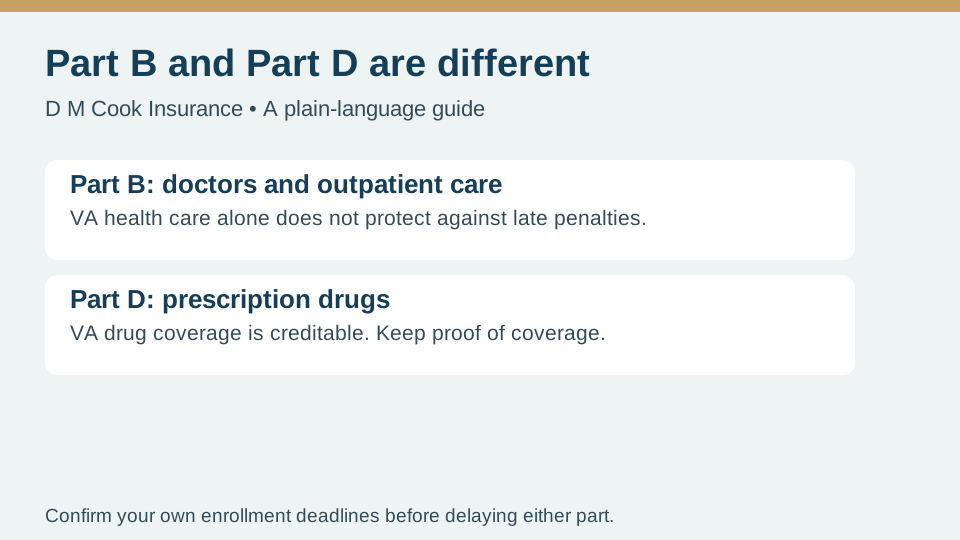
Part B helps cover outpatient medical care, including doctor visits, preventive services, durable medical equipment, and many other medical services. It usually has a monthly premium. That cost can make it tempting to delay when you are already receiving VA care, but VA health care by itself does not create the same protection from a late Part B penalty as qualifying active employer coverage.
Part A is the hospital side of Original Medicare. Many people qualify for premium-free Part A based on work history, but eligibility and premiums are individual. Do not assume that accepting Part A answers every other Medicare question. Part A, Part B, drug coverage, and any private plan choice each have their own purpose, timing, and cost. Looking at the pieces separately makes the larger decision much easier to understand.
VA itself encourages veterans who have VA health care to enroll in Medicare when they become eligible. Its guidance on Medicare and other insurance points to two practical reasons: Medicare can cover care from non-VA providers, and a later Part B enrollment can bring a penalty if a veteran delayed without a qualifying exception.
The risk is not just a future fee. If you decide later that you need Part B, you may have to wait for an available enrollment period before coverage begins. That can be a serious inconvenience if a civilian specialist, outpatient treatment, or care while away from home becomes important before your Part B is active. Enrollment timing is personal, so confirm your exact situation with Social Security before you delay, cancel, or reenroll.
What Medicare Can Add to VA Health Care
Medicare can broaden your choices beyond the VA health system. With Original Medicare, you can generally use doctors and hospitals that accept Medicare. With a Medicare Advantage plan, access depends on that plan’s network, service area, and rules. Either way, Medicare can be useful if a VA referral is not the route you are using for a particular appointment.
Consider a few everyday situations. You may spend part of the year away from home and want a clearer path to covered civilian care. You may want to keep a long-standing non-VA specialist. You may need care after an emergency, when the nearest suitable facility is not a VA facility. Or you may simply want a backup if a future change affects the VA care arrangement you rely on. Medicare does not solve every coverage question, but it gives you another coverage route to evaluate.
If you use Medicare outside VA, make sure the provider understands which coverage is being billed. A civilian office visit under Original Medicare follows Medicare’s provider and coverage rules. A Medicare Advantage visit follows the plan’s network and authorization rules. A VA community care referral follows the VA authorization. Those routes can look similar on a calendar, but they are not interchangeable at billing time.
Do You Need Medicare Advantage If You Have VA Benefits?
You do not need to enroll in Medicare Advantage simply because you have VA benefits. Medicare Advantage is one way to receive Medicare-covered services through a private plan. It may appeal to someone who wants one plan structure for civilian medical care and may value included drug coverage or extra benefits. It also brings plan-specific networks, copays, service areas, and approval rules.
For a veteran who uses VA for most care, the key question is how a Medicare Advantage plan would fit the care received outside VA. Check whether the civilian doctors, hospitals, and specialists you would actually use are in the specific plan’s network. Review its maximum out-of-pocket amount, referral rules, and prior authorization requirements. A plan marketed toward veterans is not automatically a fit, and it is not a substitute for confirming how you will access both VA and civilian care.
If broad civilian provider choice matters more to you, Original Medicare may be worth comparing. Some people then consider a Medicare Supplement policy to help with certain Original Medicare cost sharing. The right comparison depends on your doctors, travel, prescriptions, budget, and how often you expect to use care outside VA. D M Cook Insurance’s Medicare Advantage guidance and Medicare Supplement guidance explain the practical differences.
Part D Is a Different Question From Part B
Part D is Medicare prescription drug coverage. VA prescription coverage is generally considered creditable drug coverage, which means it is expected to pay at least as much as standard Medicare drug coverage on average. Medicare lists VA coverage among the forms of creditable prescription drug coverage. That can protect you from a Part D late enrollment penalty while you keep the coverage.
That protection is specific to prescription coverage. It does not turn VA health care into Part B coverage or protect you from a Part B penalty. Keeping those two questions separate is one of the clearest ways to avoid a costly misunderstanding. A veteran may reasonably decide to rely on VA pharmacy benefits for now while still enrolling in Part B for civilian outpatient care access.
Part D can still be worth comparing if you want to fill prescriptions from a civilian doctor at a local pharmacy, travel often, or have medicine needs that do not fit your current arrangement. If you enroll in both VA drug coverage and Part D, you cannot use both benefits for the same drug at the same time. Before adding a plan, compare your actual medications, refill pattern, pharmacy access, and expected full-year costs. The Part D drug coverage guide explains the checks that matter.
Community Care, Civilian Care, and Emergencies
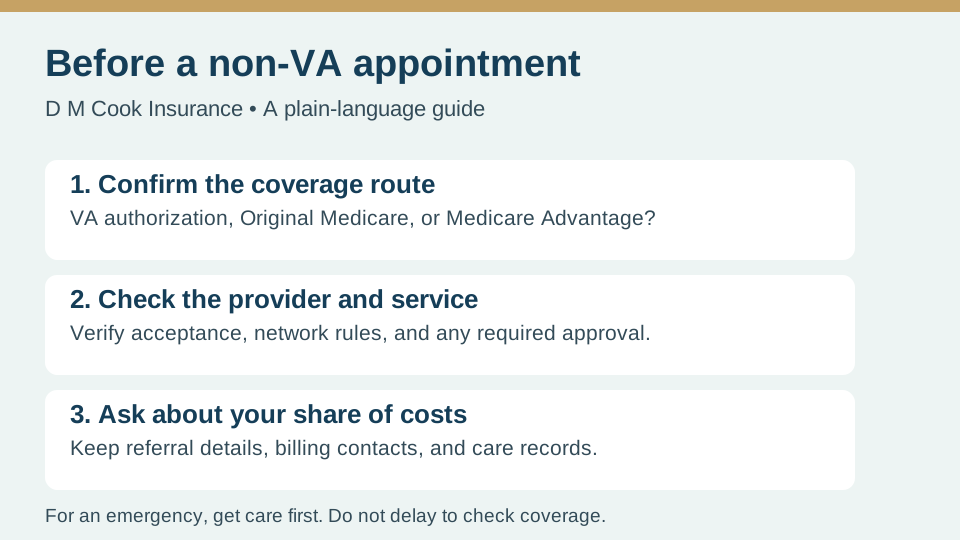
VA community care can make it possible for eligible veterans to receive certain care from non-VA providers, but it is not blanket approval to use any civilian provider whenever you wish. For planned care, confirm the authorization, the provider, the service, and the dates before the appointment. The VA’s community care overview explains that eligibility and authorization requirements apply.
If you decide to use Medicare for a civilian appointment instead, follow Medicare or your Medicare Advantage plan’s rules. Do not assume VA will pick up a Medicare copay or that Medicare will automatically pay for a service under a VA authorization. Ask the office which coverage route it will use before the visit, and keep any authorization information together with your appointment details.
In an emergency, get emergency care first. Do not delay treatment while sorting out coverage cards. Afterward, notify the appropriate program as soon as you can and ask the provider’s billing office which coverage was submitted. VA has separate rules for emergency treatment at non-VA facilities, including notification expectations, and those rules are worth reviewing with VA directly after an event.
A Simple Way to Decide What to Review
Start with your current pattern of care, not a television ad or a plan name. Write down where you receive primary care, which specialists you see, where you fill prescriptions, and where you would go if you needed care while traveling. Then note any care outside VA that you want to preserve or make easier to access.
Next, separate the decisions. For Part A and Part B, ask whether you want access to Medicare-covered hospital and outpatient care outside the VA system, what the Part B premium means for your budget, and what could happen if you delay. For Part D, ask whether VA pharmacy coverage meets your needs, whether it is creditable, and whether local pharmacy access would add real value.
Then check the dates before making a change. Most people have a seven-month Initial Enrollment Period around their 65th birthday, but automatic enrollment and later enrollment rights depend on individual circumstances. The site’s Georgia Medicare enrollment guide can help you organize the dates and documents to discuss, while Medicare’s enrollment timing guidance is the right place to confirm the rule that applies to you.
Original Medicare and Medicare Advantage: Which Comparison Matters?
Veterans who decide to keep Medicare still have a choice about how to receive it. Original Medicare is Part A and Part B. It generally allows you to see any doctor or hospital that accepts Medicare, anywhere in the United States. You can add a stand-alone Part D plan if you want Medicare drug coverage, and some people also consider a Medicare Supplement policy to help with certain Medicare cost sharing.
Medicare Advantage is a private-plan alternative to Original Medicare. Plans must cover the services Original Medicare covers, but they set their own networks, copays, prior authorization processes, and service areas. Many include prescription drug coverage. That structure may work well for someone who is comfortable with the local network and wants a plan designed around one set of civilian benefits. It may be less appealing for someone who wants the broadest possible civilian provider access or expects care in several locations.
VA coverage does not answer that Medicare choice for you. A veteran who uses VA for primary care may still prefer Original Medicare for a civilian specialist who accepts Medicare. Another veteran may use a local Medicare Advantage network for most non-VA care and reserve VA for other services. The practical test is not which option sounds simplest in a brochure. It is whether the option fits the providers, places, prescriptions, and care rules you expect to use outside VA.
Before choosing a Medicare Advantage plan, look beyond the premium. Check the network for each civilian doctor and hospital you would be likely to use, not just one preferred provider. Review specialist copays, inpatient costs, the maximum out-of-pocket amount, and prior authorization requirements. The site’s Medicare Advantage comparison guide gives a practical order for those checks.
Three Common Situations to Think Through
You mainly use VA care and are healthy today. It may be tempting to judge Part B only by whether you used it last year. Instead, ask what you would do if you needed a non-VA specialist, moved, or had a medical event while traveling. You do not need to predict every emergency. You do need to understand what care options remain open if your needs change, and what delayed Part B could mean for future enrollment and cost.
You use VA for prescriptions but civilian doctors for some care. This arrangement can work, but the pathways must be clear. A civilian doctor may prescribe a medication that you want filled through VA, or you may prefer to use a local pharmacy under Part D. Ask about the specific prescription before assuming either route will work. Keep each care team informed so medication lists and follow-up treatment do not drift apart.
You are considering leaving a Medicare plan because VA care now meets your needs. Slow down before ending coverage. Ask what happens to your right to reenroll, what penalties or gaps may apply, and whether a pending specialist visit or planned treatment will use VA authorization or Medicare. A plan that seems unnecessary during a quiet year can be difficult or expensive to replace when circumstances change.
When You Need an Official Answer
Some questions have to be answered by the program that holds your record. Contact VA for your eligibility, priority group, community care authorization, emergency-care notification, or an individual VA claim. Contact Social Security or Medicare for your personal enrollment rights, Part B status, and penalty questions. Contact a plan or pharmacy for a specific drug, network, formulary, or billing question.
That is not passing you from office to office. It is the safest way to get a decision tied to your own dates, coverage, and care arrangement. An insurance conversation can help you identify the questions to ask and compare the Medicare choices that are available, but it should not replace a direct answer from VA, Social Security, Medicare, or a provider when the question is about a personal record or authorization.
Questions to Bring to a Coverage Review
Bring your Medicare card if you already have one, your VA enrollment information, a current medication list, the names of civilian doctors you want to keep, and any plan materials you are considering. You do not need to share your entire medical history to begin a useful review. The goal is to identify the coverage details that could change your access or costs.
Good questions include: Which benefit will I use for my regular appointments? If I need a civilian specialist, will I use VA community care or Medicare? What happens if I delay Part B? Is my VA drug coverage creditable, and how should I keep proof of it? If I choose a Medicare Advantage plan, are my likely civilian providers in network?
Also ask what would change if your circumstances change. A move, a new specialist, a new prescription, a long trip, or a change in VA access can make a once-simple decision worth revisiting. A coverage choice should fit the life you actually expect to live, not just the care you used last year.
How D M Cook Insurance Can Help
D M Cook Insurance helps Georgia residents compare Medicare choices in plain language. David can help you prepare the questions around civilian doctors, medications, pharmacy access, travel, budget, VA care, and enrollment timing. The goal is not to replace VA’s advice about VA eligibility or authorization. It is to make the Medicare side of the decision easier to understand before you make a change.
For a no-cost Medicare conversation, bring the materials you already have and call 404-992-8071 or send D M Cook Insurance a question. For VA eligibility, community care authorization, or a VA claim, contact VA directly so the answer is tied to your own record.
Frequently asked questions
Do I need Medicare if I have VA health care?
Usually, enrolling in Medicare when you are eligible is worth serious consideration. VA health care and Medicare are separate benefits, and Medicare can provide another path to covered civilian care. VA encourages veterans to enroll in Medicare and warns that delaying Part B can lead to a later penalty if no qualifying exception applies.
Does VA coverage let me delay Medicare Part B without a penalty?
VA health care alone does not provide the employment-based protection that can allow some people to delay Part B without a penalty. Confirm your personal enrollment rights with Social Security before delaying, canceling, or reenrolling in Part B.
Can I have Medicare Advantage and VA benefits?
Yes. You can have both, but they remain separate coverage arrangements. If you use Medicare Advantage for civilian care, the plan’s network, costs, and authorization rules apply. VA benefits apply to VA-authorized care.
Do I need Part D if I use the VA pharmacy?
Not necessarily. VA prescription coverage is generally creditable for Part D purposes, which can protect you from a Part D late enrollment penalty while you keep it. Part D may still be useful if you want civilian prescriptions filled at a local pharmacy or have other pharmacy-access needs.
Will VA pay my Medicare copays or deductibles?
Do not assume it will. VA health care is not a Medicare Supplement policy, and Medicare and VA generally cannot pay for the same item or service. Confirm the coverage route and likely costs before planned care.
Related posts
Medicare
Medicare and VA Benefits: How They Work Together
Understand Medicare and VA benefits, Part B enrollment, VA drug coverage, civilian care, and the questions to ask before choosing a plan.
Read article
Medicare
Does Medicare Cover Dental? What to Know
Does Medicare cover dental? Learn what Original Medicare usually excludes, when limited coverage may apply, and how to compare dental benefits.
Read article
Medicare
When Is Medicare Annual Enrollment? Dates to Know
Medicare Open Enrollment runs October 15 through December 7. Learn what you can change, what to review, and which deadlines are different.
Read article