

VA prescription coverage is generally creditable coverage for Medicare Part D, so many veterans can delay Part D without a late-enrollment penalty while they remain eligible for VA drug benefits. That does not automatically mean Part D has no value. The right decision depends on where your prescriptions come from, where you want to fill them, whether you use civilian doctors, and how much flexibility you want outside the VA system.
The important distinction is simple: VA and Medicare Part D are separate pharmacy benefits. They do not combine to pay for one prescription at the same time. Before enrolling in, dropping, or delaying a drug plan, it helps to map out the route each prescription will take. That small step can prevent a surprise at the pharmacy counter or a coverage gap after a change in care.
This article focuses on prescription coverage. It does not answer the separate Medicare Part B question. VA health care can work alongside Medicare, but it does not function like a Medicare Supplement policy or employer coverage. For the wider coverage decision, read D M Cook Insurance’s guide to Medicare and VA benefits.
The Short Answer: VA Drug Coverage Is Usually Creditable
The Department of Veterans Affairs says enrollment in VA health care counts as creditable coverage for Medicare Part D. In plain language, VA drug coverage is considered at least as good as standard Part D for the purpose of avoiding a late-enrollment penalty. Medicare’s current prescription drug coverage guide advises people with VA benefits to save the yearly notice that confirms whether their coverage is creditable.
Keep that notice with your Medicare papers. If you later lose VA drug coverage or decide to enroll in Part D, the notice helps show that you had qualifying coverage. Do not rely on an old memory or a verbal answer from years ago. The plan, VA, or Medicare can tell you which documentation applies to your situation when you are considering a change.
Creditable coverage protects against a Part D late-enrollment penalty. It does not make every pharmacy arrangement equally convenient, and it does not mean every medication will be available in the same way through VA and Part D. That is why a veteran can sensibly keep VA pharmacy benefits, skip Part D for now, and still review the choice again if doctors, medications, travel, or pharmacy needs change.
When Part D May Still Be Worth Comparing
Part D may be useful when a prescription is written by a civilian doctor and you want to fill it at a local retail pharmacy. VA may cover prescriptions through its own process, but a civilian prescription does not automatically move through that process in the way you expect. Ask the VA care team or pharmacy about the exact medication before assuming it can be filled through VA.
A separate Part D plan can also be worth exploring when local pharmacy access matters, when you travel regularly, or when a medicine you need is not a good fit for your current VA arrangement. Medicare explains that Part D plans have their own formularies, pharmacy networks, tiers, deductibles, and coverage rules. The best plan is not the one with the lowest premium. It is the one that handles your actual prescriptions at the pharmacies you can use.
There is a tradeoff. Medicare and VA state that you cannot use both benefits for the same prescription at the same time. If you enroll in Part D, you also cannot use the VA Meds by Mail program. The official Medicare guidance for veterans is clear on both points. Compare the convenience and likely cost before adding a second drug benefit.
Choose the Coverage Route Before You Fill
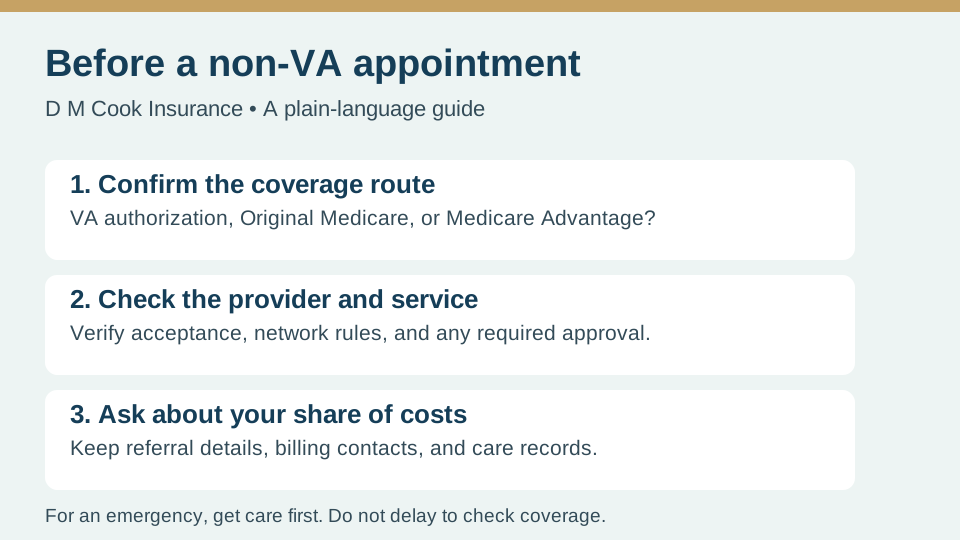
For each ongoing medication, decide whether you plan to use the VA route or a Medicare Part D route. The decision is not permanent for every possible future prescription, but it should be clear before a refill is due. Write down the prescriber, the pharmacy or mail-order option, the coverage card you will present, and the person to call if the prescription needs approval.
If you use VA for a prescription, confirm the prescription was sent where it needs to go and ask about the refill process. If you use Part D, check the plan formulary, drug tier, pharmacy network, deductible treatment, and any prior authorization or quantity limit. Medicare’s drug-plan rules overview explains why a covered drug can still have steps or limits attached to it.
This approach is especially important after a hospital stay, a new specialist visit, or a change in medication. Tell each care team what you take and where you fill it. A current medication list helps prevent duplicate therapy and gives the next clinician a clearer picture of what has already been prescribed.
A Practical Comparison Checklist
Start with your medication list. Include the exact drug name, dose, how often you take it, and whether a particular brand or formulation matters. Add the doctors who prescribe it and the pharmacies you can realistically use. A list based on general categories, such as “blood pressure medicine,” is not enough for a careful plan comparison.
Then compare the real experience of each route. With VA, ask about formulary status, the process for prescriptions from civilian clinicians, refills, delivery, and any copay that applies to you. With Part D, look at the premium, deductible, expected drug cost, preferred pharmacy price, and rules attached to each medicine. D M Cook Insurance’s Part D deductible guide explains why one number never tells the whole cost story.
Also compare access, not just price. A VA route may be the better value for a medicine you receive routinely through the VA. A local pharmacy may be more useful when you are away from home, when a civilian specialist writes a new prescription, or when timing makes a local fill important. The right answer can differ from one medication to another.

What Happens If You Lose VA Drug Coverage?
If you lose VA health care or other creditable prescription coverage, timing matters. VA says there is no Part D penalty when you enroll when first eligible or within 63 days after you no longer have VA health care or other creditable drug coverage. Do not wait until a refill runs out to learn the rule. Contact Medicare, VA, or the plan promptly, and keep the documentation that shows the end date of your coverage.
This is also a reason not to cancel coverage casually. A quiet year with few prescriptions can make a drug benefit feel unnecessary. But if a new diagnosis, move, or change in access happens later, you will want a clear record of your enrollment choices and the time limits that apply. Personal enrollment rights can turn on dates and facts that a general article cannot see.
How to Review Your Prescription Coverage Each Year
Set aside time to review your coverage before you need a refill. Start with the prior year’s medication list, then cross out medicines you no longer take and add every new prescription, dose change, and specialist. Include medicines you only use occasionally. A plan can look like a strong fit until an as-needed inhaler, eye drop, or expensive short-term medication is left off the comparison.
Next, decide which prescriptions you expect to use through VA and which you would rather fill locally. This is also the moment to review travel and caregiver needs. A spouse or adult child who helps with pickup may need a local pharmacy option. A long stay away from home can make a mail-order routine less convenient. There is no universal answer, but there should be a deliberate answer for the medicines that matter most.
If you are comparing Part D plans, use the official Medicare Plan Finder with the exact drug name, strength, dose, and pharmacy. Medicare plans can differ in both formularies and pharmacy pricing. Check whether the pharmacy is preferred, standard, mail order, or out of network. The same drug can have a noticeably different price depending on that detail, even when the monthly premium looks similar.
Save your comparison notes, plan materials, and VA creditable-coverage notice together. At the next review, those records make it easier to spot what changed. If you have an uncertain answer about a VA medication, a community-care authorization, or an individual enrollment window, get that answer directly from VA, Medicare, Social Security, or the plan before making an irreversible change.
A useful review looks at the whole year, not just the next month. Add the premiums you would pay, expected copays or coinsurance, a deductible when it applies, and the likely cost of the medications you take regularly. Then consider the less predictable question: what would happen if a doctor changes a medication, a preferred pharmacy closes, or you need a quick local fill while traveling? A slightly higher premium can sometimes buy an access option that matters when life gets inconvenient.
Do not make the comparison alone if the details feel scattered. A pharmacist can explain a particular medication and pharmacy process. VA can explain its benefits and prescription route. Medicare or a plan can explain enrollment and formulary rules. An independent conversation can help put those answers beside your doctors, budget, and daily routine, so the final choice is based on the facts that affect you rather than a general promise in a brochure.
Common Misunderstandings to Avoid
“VA pays after Medicare.” Not for the same prescription. VA and Medicare Part D are separate paths, not primary and secondary drug plans for one fill. Choose the route before the pharmacy submits the claim.
“Creditable means I never need to think about Part D.” It means you may be able to delay Part D without the late penalty while the creditable coverage continues. It does not decide whether Part D could offer useful local pharmacy or civilian-prescriber access for your own needs.
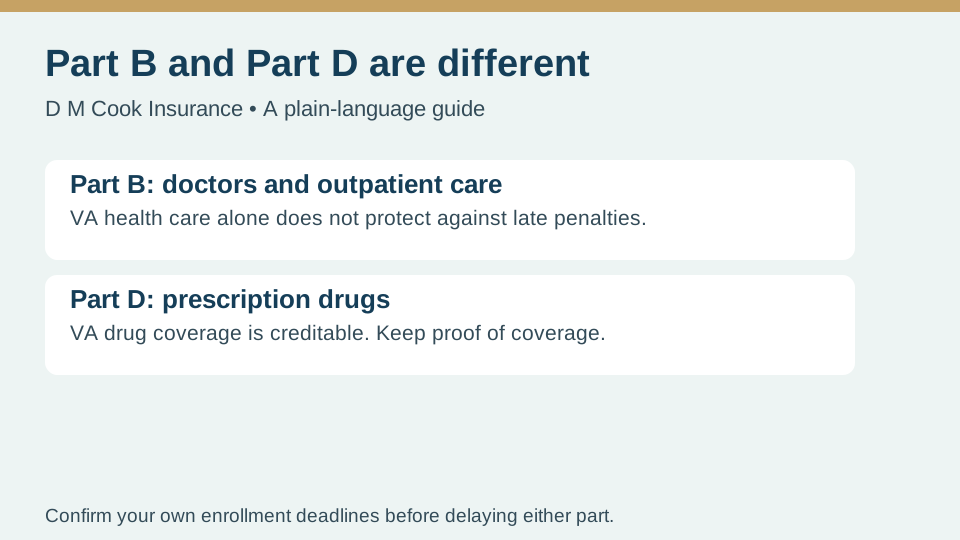
“VA coverage answers every Medicare question.” It does not. Prescription coverage is Part D. Civilian outpatient care and Part B are a different question. Keep the decisions separate so one correct answer does not get stretched into the wrong conclusion.
How D M Cook Insurance Can Help
D M Cook Insurance helps Georgia veterans and their families organize the Medicare side of a coverage decision. David can help you compare Part D options around medications, pharmacy access, civilian doctors, budget, and travel. The goal is to make the tradeoffs easier to see, not to replace a personal answer from VA about eligibility, authorization, or a VA prescription.
Bring your current medication list, VA paperwork, Medicare card if you have one, and the names of the pharmacies you use. Call 404-992-8071 or send D M Cook Insurance a question for no-cost Medicare guidance. For an individual VA coverage or pharmacy decision, contact VA directly so the answer is tied to your own record.
Frequently asked questions
Do I need Medicare Part D if I have VA benefits?
Not always. VA prescription coverage is generally creditable for Part D, so eligible veterans can often delay Part D without a late-enrollment penalty while they keep VA drug coverage. Part D can still be worth comparing if local pharmacy access, civilian prescriptions, travel, or a specific medication makes it useful.
Can I use VA coverage and Medicare Part D for the same prescription?
No. VA and Part D do not coordinate to pay for the same drug at the same time. Before a refill, decide which coverage route you will use and confirm the pharmacy or VA process for that medicine.
Will I lose VA Meds by Mail if I enroll in Part D?
Yes. Medicare states that someone who joins a Medicare drug plan cannot use the VA Meds by Mail program. Compare the value of that program and your local pharmacy needs before enrolling in Part D.
What should I save as proof of VA drug coverage?
Save the annual notice from VA that confirms whether your prescription coverage is creditable. If your coverage changes, keep records that show the date it ended and contact Medicare or a plan promptly about your enrollment window.
Does VA drug coverage protect me from a Part B penalty?
No. Part D and Part B have different rules. VA drug coverage may be creditable for Part D, but it does not create the same protection for a delayed Part B enrollment. Confirm your Part B timing with Social Security before delaying or ending coverage.
Related posts

Medicare
Do I Need Medicare If I Have VA Benefits?
VA health care and Medicare can work together. Learn why Part B and Part D decisions still matter, what each benefit covers, and what to check before enrolling.
Read article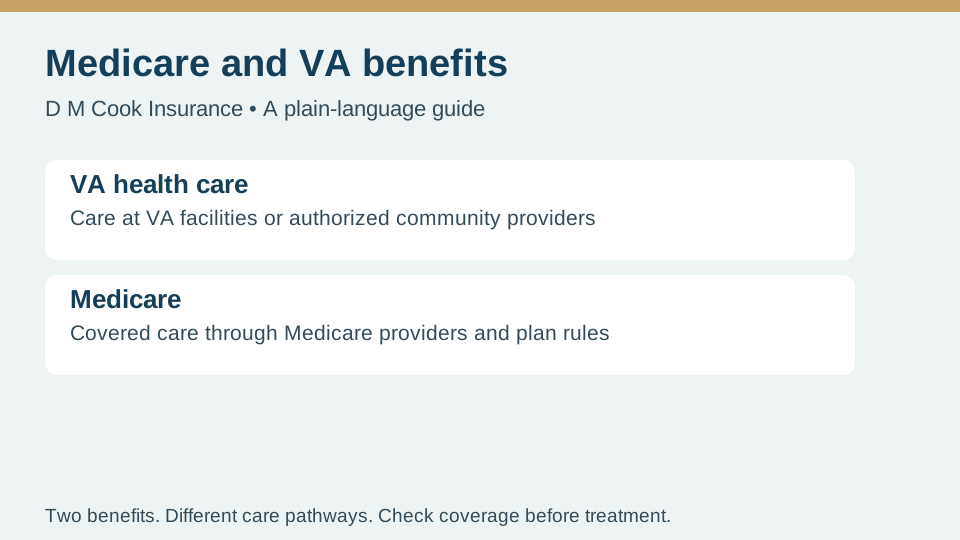
Medicare
Can You Have Medicare and VA Benefits? How Coverage Works
Can you have Medicare and VA benefits? Learn which coverage pays, why VA does not replace Part B, and how VA drug coverage works with Part D.
Read article
Medicare
Does Medicare Cover Dental? What to Know
Does Medicare cover dental? Learn what Original Medicare usually excludes, when limited coverage may apply, and how to compare dental benefits.
Read article